
When the European Union introduced the Corporate Sustainability Reporting Directive (CSRD), it drew a clear line: large companies operating in the EU would be subject to mandatory sustainability reporting requirements, while small and medium-sized enterprises (SMEs) would remain outside that scope. The VSME — the Voluntary Sustainability Reporting Standard for non-listed SMEs, developed by EFRAG — was designed with this very distinction in mind. As its name signals, the standard is voluntary. No company is legally compelled to apply it.
But does that mean companies exporting to the EU can simply ignore it?
For businesses that export to Europe, operate as suppliers to large EU-based companies, or seek financing from European banks and investors, the answer is becoming increasingly clear: VSME may be voluntary by law, but in practice, it is rapidly becoming a de facto requirement.
How Large Companies’ Reporting Obligations Cascade Down the Supply Chain
Under the CSRD, large EU companies must prepare sustainability reports in accordance with the European Sustainability Reporting Standards (ESRS). Critically, these reports are not limited to a company’s own operations. They must cover the full value chain — including suppliers, logistics partners, and subcontractors — reflecting both the company’s environmental impacts and its exposure to sustainability-related risks.
The Corporate Sustainability Due Diligence Directive (CSDDD) pushes this further, making it a legal obligation for large companies to identify and address human rights and environmental risks throughout their supply chains. Together, these two directives create a powerful upstream pressure: large EU buyers must gather sustainability data from their suppliers to fulfil their own legal obligations.
This means that a textile manufacturer, a machinery producer, or a food exporter supplying a major European brand is increasingly likely to receive formal requests for verified data on carbon emissions, energy consumption, workforce safety, water use, and waste management. These are not informal questions asked over email. They are structured, documented data requests. Companies that cannot provide satisfactory answers risk being removed from supplier lists, losing contracts, or simply becoming uncompetitive in European markets.
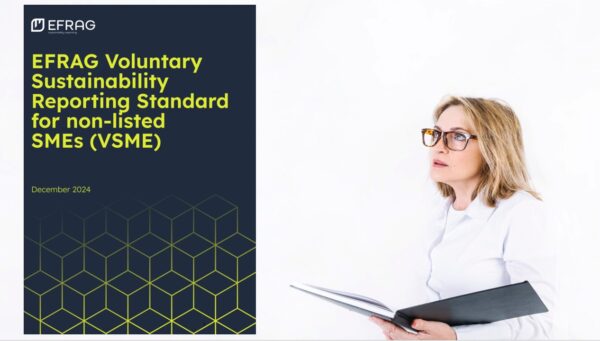
VSME Was Designed to Solve This Problem — for Both Sides
To understand VSME’s real purpose, it helps to understand the problem it was designed to solve. When EFRAG developed this standard, it faced two simultaneous challenges:
Challenge one: Large EU companies need sustainability data from their suppliers to complete their own mandatory ESRS reporting. But how are SMEs supposed to produce this data in a structured, comparable format?
Challenge two: ESRS was designed for large companies and imposes reporting requirements that would be disproportionately burdensome for smaller businesses. Applying the same framework to SMEs directly would be neither fair nor effective.
VSME sits precisely at the intersection of these two challenges. The standard is designed to be consistent with ESRS while being proportionate to the capacity and resources of smaller businesses. In this sense, VSME functions as a genuine SME shield: it protects large companies from having gaps in their supply chain reporting, while protecting small companies from being crushed under a compliance framework built for a very different kind of organisation.
The Basic Module of VSME covers core indicators — greenhouse gas emissions, energy consumption, water use, waste management, workforce health and safety — in a streamlined, accessible format. The Comprehensive Module offers additional disclosures for companies that want to provide more detailed information to banks, investors, or corporate clients. This two-tier structure means that a small exporter and a medium-sized manufacturer can both operate within the same framework without being held to the same level of detail.
“No One Has Asked For This Yet” — Why That’s Not a Safe Position
Many companies exporting to the EU take the view that since their European buyers haven’t explicitly requested sustainability data yet, the issue can wait. This is understandable — but it is increasingly risky.
CSRD implementation is phased, and large EU companies are in the process of building out their value chain data collection systems. The first wave of supplier requests is already arriving for some businesses; for others, it is only a matter of time. Being prepared when that request arrives — rather than scrambling to respond — can make a significant commercial difference.
Beyond direct buyer pressure, sustainability performance is increasingly factored into procurement decisions, pricing negotiations, and long-term contract renewals. Some European buyers already assess supplier sustainability as a baseline criterion alongside price and quality.
On the financing side, VSME explicitly acknowledges that the standard is designed not only to meet the data needs of large corporate clients but also to satisfy the requirements of banks and investors assessing sustainability risk. As European financial institutions build sustainability considerations into their credit assessment and due diligence processes, companies without structured sustainability reporting may face increasing disadvantages in accessing finance at competitive terms.
EU Standards Tend to Go Global
There is a broader dimension worth considering. While VSME and ESRS currently appear relevant primarily to EU-facing trade, the European Union has a well-established track record of setting standards that eventually become global norms. Food safety, chemicals regulation, and data privacy (GDPR) all followed a similar trajectory: introduced as EU-specific requirements, they gradually became de facto global standards that companies worldwide had to comply with to remain competitive.
Sustainability reporting is following the same path. The International Sustainability Standards Board (ISSB) is developing global sustainability disclosure standards, and multiple countries are already building national frameworks aligned with or directly derived from the EU approach. What looks today like a specifically European requirement may well become a universal expectation for international trade within the next decade.
For companies exporting to any major market — not just the EU — building sustainability reporting capacity now is an investment in long-term commercial resilience, not just regulatory compliance.
Where to Start
The good news is that VSME’s voluntary and proportionate design means there is no requirement to achieve perfection from day one. Companies can start with the Basic Module, focusing on the core metrics most relevant to their sector and their buyers’ likely data needs. What matters is getting started, establishing a baseline, and building the internal processes that will allow sustainability data to be collected and reported consistently over time.
If you are unsure where to begin — what data to collect, how to structure your reporting, or how to respond to specific requests from European clients — professional training and guidance on the VSME standard is the most effective first step.
To access our live and on-demand training programmes on the VSME standard, contact us at info@10kdanismanlik.com!







Leave A Comment