
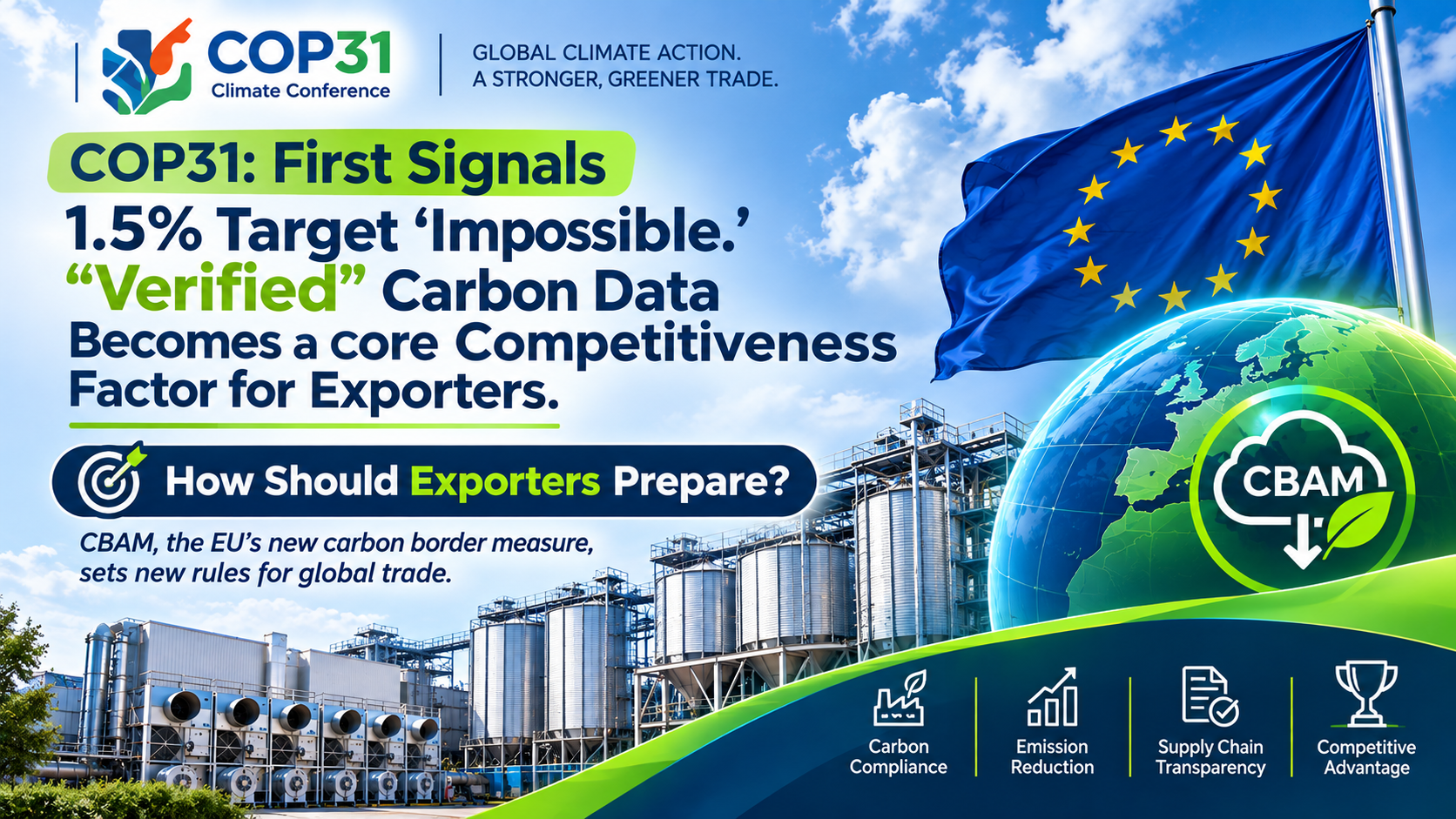
The UN Climate Change Conference COP31 is taking place in Antalya from 9 to 20 November. Türkiye holds the presidency, while Australia leads the negotiations. The message from the opening was clear: the world is on track to overshoot the Paris Agreement’s 1.5°C threshold, and what is expected now is delivery, not pledges.
For exporters, this is not a distant diplomatic matter. As climate targets get harder to reach, the EU is tracking the carbon content of imported goods more closely. The most concrete tool for this is the Carbon Border Adjustment Mechanism (CBAM).
What is the difference between 1.5°C and 2°C?
Half a degree sounds small, but its impact is large. According to a UN report, warming of 1.7–1.8°C is now considered unavoidable, which puts us right in the gap between 1.5 and 2. The Intergovernmental Panel on Climate Change (IPCC) estimates the difference as follows:
| Indicator | 1.5°C | 2°C |
|---|---|---|
| Share of world population exposed to severe heatwaves at least once every 5 years | 14% | 37% |
| People who could be exposed to flooding by 2100 (without adaptation) | up to 69 million | up to 79 million |
| Sea level rise by 2100 | 0.40 m | 0.46 m |
| Ice-free Arctic summer | once every 100 years | at least once every 10 years |
| Loss of coral reefs | 70–90% | over 99% |
| Decline in global annual fish catch | 1.5 million tonnes | 3 million tonnes |
| Global GDP loss by 2100 | 0.3% | 0.5% |
These are not measured figures but scientific projections by the IPCC, the most authoritative international body on the subject. We would have liked to calculate how many additional deaths this half-degree gap will cause, but the available data does not allow it. What we can say is this: the clearest indicator is that the share of people exposed to severe heatwaves nearly triples. In summer 2026, heatwaves are estimated to have caused more than 50,000 deaths in European cities alone, about two-thirds of them attributed to climate change.
Do the math yourself.
And that is only the heatwave risk. Sustainability risks do not end there: there are floods, there are wildfires…
Why is 2026 critical for CBAM?
For goods covered by CBAM, the purchase of certificates for 2026 imports starts on 1 February 2027. In other words, what your EU buyer pays in 2027 will be calculated from the emissions data you provide this year. If a supplier cannot provide verified actual data, default values apply. These are usually higher than actual values, and a mark-up is added that rises every year.
An example: 1,000 tonnes of hot-rolled steel
Imagine 1,000 tonnes of hot-rolled flat steel (CN 7208) sold from Türkiye to the EU.
- Default value: 2.43 t CO₂e per tonne for Türkiye. A mark-up of 10% applies in 2026, 20% in 2027 and 30% from 2028 (2026: 2.67; 2028: 3.16).
- Verified value: around 0.70 t CO₂ per tonne for a Turkish electric arc furnace producer.
- Carbon price: the CBAM certificate price for Q3 2026 was €82.32 per tonne of CO₂; we kept it constant.
| Year | Carbon cost with default value | With verified data | Difference | Share actually payable that year | Actual difference (rough) |
|---|---|---|---|---|---|
| 2026 | €220,000 | €57,600 | €162,400 | 2.5% | ~€4,100 |
| 2027 | €240,000 | €57,600 | €182,400 | 5% | ~€9,100 |
| 2028 | €260,000 | €57,600 | €202,400 | 10% | ~€20,200 |
| 2029 | €260,000 | €57,600 | €202,400 | 22.5% | ~€45,500 |
| 2034 | €260,000 | €57,600 | €202,400 | 100% | ~€202,400 |
Per tonne, the difference is about €4 in 2026 and about €200 in 2034. For a product priced at a few hundred euros per tonne, this is a direct pricing and competitiveness issue. An EU buyer signing a long-term contract today is already factoring in the costs of the 2030s, which is why they want the data now.
This is a rough estimate: the deduction for free allocation to EU producers is simplified, and any carbon price paid in Türkiye and future price changes are not taken into account. The actual amount varies by product and installation.
The bottom line is simple: carbon data is now part of price negotiations. Exporters with their data ready sit at the table from a position of strength.
What should exporters do today?
- Calculate your product carbon footprint. A corporate footprint is a start; buyers often ask for product-level data.
- Keep your data verifiable. Energy bills, production records and raw material data should be archived regularly; if you are in CBAM scope, plan the verification process early.
- Prepare a reduction plan. Electrification and renewable energy, both highlighted at COP31, can lower both costs and carbon content.
- Look beyond carbon. CBAM currently covers iron and steel, aluminium, cement, fertilisers, electricity and hydrogen. But large EU buyers do not look at carbon alone: energy, water, waste, working conditions and governance are on the list too. They will increasingly ask suppliers to report and share data in line with the VSME (now the Voluntary Standard, VS). Whether or not your sector is covered by CBAM, this is sensible preparation.
The opportunity
Exporters who collect their data early and invest in certifications such as Environmental Product Declarations (EPDs), which are voluntary under the law but increasingly required by large buyers, gain a head start. Becoming familiar with the VSME (VS), the simplest reporting framework covering all areas of ESG, is just as valuable. These steps also make it easier to get onto large buyers’ trusted supplier lists.
At 10k Consulting, we will keep sharing updates on these topics, so follow us. We offer fast and cost-effective services to exporting SMEs throughout this process. Explore our services →

Leave A Comment